
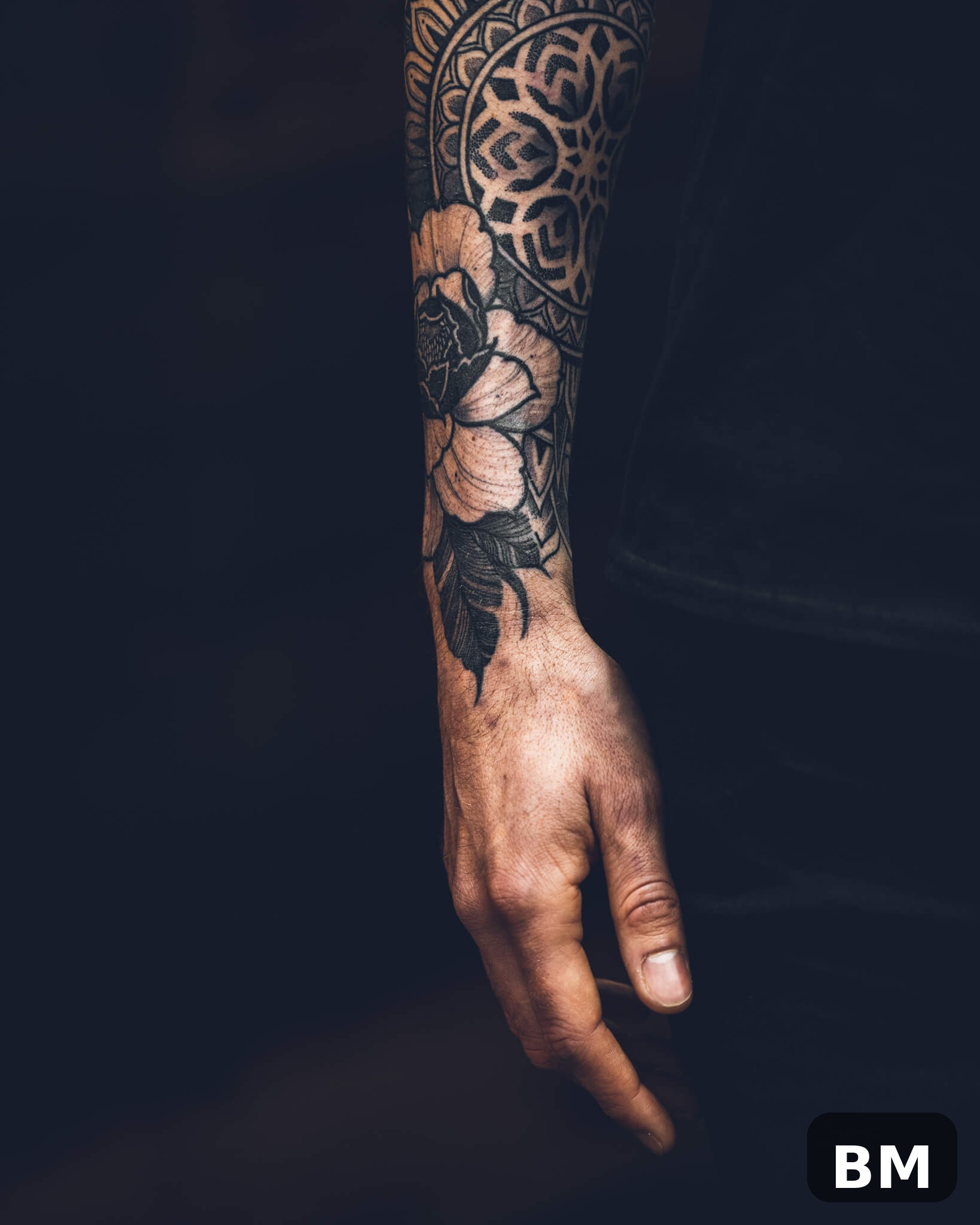
There is a moment almost every sleeve wearer recognises: the main pieces are in, the tattoos themselves are good, and yet the arm does not look finished. What you are seeing is not a bad-tattoo problem — it is a connection problem, and filler is the thing that solves it.
Tattoo filler ideas are the smaller designs, textures and background elements that sit between your headline pieces and turn a collection of tattoos into a single composition. Good filler gives the eye a path to travel, so it glides across the arm instead of stalling on patches of bare skin.
This guide gives you 35 ideas grouped by style, from bold backgrounds to micro symbols, plus a practical framework for matching filler to your gap size, your existing line weight and your budget. Because the wrong filler is worse than no filler at all — it costs the same money, and you will be looking at it for decades.
Start With the Gap, Not the Design
Before you fall in love with any specific filler, look at the spaces you are actually trying to fill. Most people do this backwards — they pick a design they like and then force it into a gap that was never the right shape. Flip that around and the decisions get much easier.
Small gaps, roughly finger-width or smaller, want the lightest touch: micro stars, dots, sparkles, tiny symbols. Anything more detailed will read as clutter once it heals. Medium gaps, the size of a coin up to a playing card, suit single elements with a bit of presence — a small flower, a word in script, a dagger or a rose. Large open areas need backgrounds, not objects: cloud bands, smoke, solid black, waves or dotwork fields that can cover real estate without introducing yet another subject to compete with your main pieces.
And be honest about the arm you have, not the arm you wish you had. Patchwork sleeves built over years by different artists are the most common filler scenario, and they are also the hardest to plan, because nothing was designed to connect. That is fine — filler exists precisely for this — but it means you should show your artist the whole arm, in natural light, at the consultation, not just the pieces you like best.
Classic Backgrounds That Unify Fast
These are the heavy lifters. They cover the most skin per session and do the most work toward making a sleeve read as one piece.
1. Solid black background. Packed black behind your existing subjects so each piece floats against depth instead of against bare skin. It is the most decisive filler there is, and it makes even faded older work look stronger by contrast. The trade-off is real: anything added later has to sit on top of black, and laser removal over dense black is slow.
2. Japanese cloud bands. Stylised kumo clouds threading between subjects, wrapping around whatever shape they meet. They scale from a two-inch gap to a full upper arm without the concept breaking, which almost nothing else does. One honest note: this filler commits the arm to a Japanese visual language, so it clashes with fine-line or realism pieces — and it deserves respect for the tradition it comes from, not just borrowing.
3. Finger waves and water. Japanese-style water with spray and flow lines filling the space between subjects. The natural partner for koi, octopus or dragon pieces, but it works as a general connector in any Japanese-influenced arm. Like clouds, it reads correctly at almost any scale.
4. Smoke and mist. Grey atmospheric haze with no hard outlines, drifting between subjects. The quietest connector available — it adds continuity without adding anything the eye has to interpret as a subject. It belongs in dark, atmospheric arms, especially black-and-grey realism. Soft grey is fade-prone, so sun protection and an eventual touch-up are part of the deal.
5. Whip shading gradients. Smooth grey fades built from fine tapered strokes, darker at the edges and melting into skin. A modern favourite for black-and-grey sleeves because it softens transitions without the commitment of solid black.
6. Etching-style hatching. Parallel and cross-hatched lines building grey value out of line rather than solid fill. It keeps an illustrative sleeve looking drawn, which suits neo-traditional and engraving-influenced work. Ask to see healed photos: hatching packed too tightly can blur into a grey smudge as it ages.
7. Stipple dotwork fields. Dense dots building a soft grey tone between subjects, sitting halfway between bare skin and solid black. Beautiful and subtle, but brutally honest about time — stipple is applied point by point, so large areas are among the slowest and most expensive filler you can choose.
Stars, Sparkles and Celestial Fillers
8. Micro stars and sparkles. Tiny four-point sparkles scattered through small gaps, reading the negative space as night sky. Elegant, cheap per piece, and they add depth without adding mass. The warning: very small stars need genuine fine-line precision, and tight points can blur together by year five — ask for healed photos first.
9. Constellation lines. Dotted lines connecting small stars into real or invented constellations. Lovely in sleeves with celestial, mythological or nautical subjects, and it turns random dots into something that feels designed.
10. Moon phases. A small arc of crescent-to-full moons tucked into a curved gap. The natural curve of the motif fits the arm’s own curves, which is why it looks so settled once healed.
11. Sun rays. Fine radiating lines extending from behind an existing piece, like light coming off a subject. They occupy space without adding visual weight, and they are one of the least committal options on this list.
12. Comets and shooting stars. A small streaked star with a dotted tail, drawn to follow the limb’s direction. The implied movement makes it feel alive, and it works at almost any size.
Botanical Fillers
13. Climbing vines and tendrils. Thin stems winding through open skin and linking subjects together. This is the most forgiving filler on the list: vines follow irregular paths by nature, so they fit narrow channels and connect pieces that were never designed to relate. It is also the filler people are least likely to regret, because it can be added to over years without the plan collapsing.
14. Wildflower clusters. Scattered small blooms in two or three flower shapes, arranged with a little deliberate chaos. They fill gaps like a bouquet and make unrelated tattoos feel intentional. Mix at least three flower shapes so it does not look stamped from one template.
15. Single-stem sprigs. One fine stem with a few leaves, placed diagonally through a narrow gap. The simplest botanical filler there is, and quietly one of the most effective — it reads as grown, not placed.
16. Japanese peonies. The workhorse flower of irezumi, and structural for a reason: the large rounded silhouette covers real area while still reading as one clean shape from across a room. Paired with cloud or wind bars, peonies let an artist fill a whole upper arm without tipping into clutter. They do need room — squeezed small, the layered petals collapse into a blob.
17. Lotus and water lilies. Layered petals that suit dotwork, black-and-grey and fine-line sleeves equally. The symmetry of the flower gives structure to arms that are otherwise all organic flow.
18. Ferns and palm fronds. Feathery repeating leaflets that fan naturally across curved surfaces. A good middle option when you want filler that is decorative but not floral — a request artists hear more often than you would think.
19. Cherry blossoms. Loose clusters of five-petalled blossoms with a few drifting petals, a classic in Japanese-influenced work. The scattered petals do real compositional work, carrying the eye between pieces the way stepping stones carry a footpath.
Script and Lettering Fillers
20. Word banners. A short word or name on a ribbon banner tucked between pieces, in traditional or script lettering. Banners are honest filler: they were invented to fill awkward spaces on flash sheets, and they still do the job perfectly.
21. Coordinates. The latitude and longitude of a meaningful place, in clean typewriter-style lettering. Personal, compact, and it fits into gaps too small for almost anything else.
22. Roman numerals. Dates rendered as numerals — a birth, a loss, a year that matters. They fill narrow vertical or horizontal gaps neatly and age well because there is nothing delicate to blur.
23. Wrapping script lines. A short phrase or quote set in flowing script that curves around the arm between pieces. Beautiful when the lettering artist is good, disastrous when they are not — lettering is a specialism, so check this specific skill in a portfolio, not just the artist’s general work.
Ornamental and Symbolic Fillers
24. Mini daggers. Small simple blades, sometimes with a few drops of blood or a flower threaded through. A staple of traditional flash that fills narrow gaps with unmistakable attitude.
25. Diamonds and gems. Faceted stones in simple linework, catching the eye as bright points between heavier pieces. They work especially well as bridges between bold traditional work and lighter elements.
26. Horseshoes and anchors. Classic good-luck and nautical symbols at filler scale. Each is a complete little design, but collectively they fill space without competing with the main subjects — and they carry a century of tattoo history with them.
27. Tiny crosses and charms. Small crosses, evil eyes, hamsa hands or four-leaf clovers. Meaningful without being loud, and genuinely small enough for the tightest gaps.
28. Lightning bolts and arrows. Sharp, simple, and directional — they can point the eye along the arm toward your best piece, which is a trick composition artists use deliberately.
Traditional Flash Fillers
29. Traditional rose. Bold outline, simple shading, red and green or straight black-and-grey. The rose has been filling gaps in American traditional sleeves for over a century because the shape is instantly readable at any size and fills space efficiently. The one rule: do not default to six identical roses, or the arm starts to look like a stock sheet.
30. Swallow or sparrow. Small, dynamic, and deeply traditional — swallows were sailor tattoos long before they were fashion. Their swept shape fits curved gaps beautifully.
31. Sacred heart. The flaming heart with thorns and rays, in the bold traditional style. Surprisingly effective filler because the radiating elements reach into surrounding space on their own.
32. Dice and playing cards. Small, angular, and full of old-school charm. A pair of dice tucked into a gap is one of the oldest filler tricks in the book, and it still works.
33. Spiderweb elbow. The classic elbow filler — the joint’s natural shape practically draws it for you. It is a commitment to a specific look, but on the right arm nothing else fits that spot half as well.
Geometric and Dotwork Fillers
34. Partial mandalas. Full or cropped mandala patterns occupying irregular gaps. Their advantage is croppability — a mandala can be cut off by a subject or by the edge of the arm and still look complete, which is not true of most representational filler. The radial structure also creates rest points for the eye between busy subjects. Symmetry on a curved arm is the hard part, so book someone who genuinely specialises in this.
35. Sacred geometry patterns. Hexagons, line grids, flower-of-life fragments and thin geometric bands running through the gaps. They give an organic sleeve a structural spine to hang off, and the contrast between order and organic subjects reads as intentional design. Be aware this is unforgiving work — a line that drifts a millimetre across a bicep is visible forever, so this is not the place to book a cheap session.
Practical Tips Before You Book
Match the line weight first. This is the single most expensive mistake in filler. A fine botanical sprig placed beside bold traditional outlines simply disappears; heavy black beside delicate fine-line work crushes it. Subject matter can vary — weight really cannot. Hold a stencil mock-up against the arm before anyone picks up a machine.
Do not fill everything in one session. Background and blackout passes are long, demanding sits, and filler almost always looks heavier fresh than it does at six weeks. Build it over several sessions, let each pass heal, and judge tone through healed skin, not swelling.
Leave some skin alone on purpose. A sleeve with no rest in it becomes visual noise. Japanese sleeves traditionally keep noticeable open skin as part of the composition, and over-filling one is a recognised way to ruin it. If your arm reads as unfinished, ask whether the problem is missing filler or uneven distribution of the pieces you already have.
Budget honestly. Filler is usually charged by the hour like any tattoo work, and background filler eats hours — large dotwork or blackout areas can run into multiple full-day sessions. Get the estimate for the whole background, not just the first pass.
Respect the culture you borrow from. Japanese clouds, waves and peonies, Filipino batok geometry, Polynesian tribal patterns — these carry meaning in living traditions. If you wear them, understand them, and ideally work with an artist trained in the practice rather than one copying the look.
Use one artist or one plan. Different artists for the subjects and the filler can work, but only when the second artist is genuinely given freedom to respond to the first. Handing a stranger a photo and saying “fill the gaps” is how arms end up looking argued-over. As the team at Bilium Magazine often notes when covering body art culture, the best-looking sleeves are the ones where every session served the same composition.
Frequently Asked Questions
What is the best tattoo filler for small gaps?
Micro stars, sparkles, dots, tiny crosses and single-stem sprigs. Keep it genuinely small and simple — an ornamental element with too much internal detail stops being filler and becomes another subject competing with your main pieces.
How much does tattoo filler cost?
Most artists charge their standard hourly rate, commonly £80–£150 an hour in the UK and $150–$250 in the US, and background work is slow. A full sleeve background can easily run to several sessions, so ask for an estimate of the total project rather than budgeting session by session.
Can filler be added years after the original tattoos?
Yes — most sleeves are built this way rather than planned whole. The main consideration is that older pieces will have softened, so fresh filler can look noticeably crisper beside them. Many artists suggest a light touch-up of the existing work at the same time so everything sits at a similar weight.
Does filler hurt more than a regular tattoo?
It depends more on the area and the session length than the technique. Large background and blackout passes are often described as harder going than outline work, mainly because they cover more skin for longer. The inner arm, elbow ditch and armpit tend to be the most sensitive parts of a sleeve for most people.
Should I get filler from the same artist who did my pieces?
It helps, but it is not mandatory. What matters is a shared plan: the filler artist needs the freedom to respond to the existing work rather than just stamping their own style into the gaps. If you switch artists, bring clear photos of the whole arm in natural light to the consultation.
Will a black background make future tattoos or laser removal harder?
Yes. Anything added later has to work on top of packed black, which narrows your options, and dense black over large areas makes laser removal slower and more difficult. Treat blackout and heavy background black as deliberate, near-permanent decisions — discuss them at the consultation, not after the ink is in.
Bottom Line
Filler is not the stuff you add to a sleeve when you run out of ideas — it is the thing that turns a collection of tattoos into one tattoo. Start from the gaps you actually have, match the line weight of the work already on your skin, and give the project the sessions it deserves instead of rushing it. The arm you will love at fifty is the one where every piece, including the quiet bits in between, was chosen on purpose.
