
Best Pretzel with Cheese Dip Near Me: Where to Get It Right
There’s a reason the best pretzel with cheese dip near me is one of the most satisfying searches you can run. A warm soft pretzel — chewy, salted, with that deep mahogany crust — torn open and dragged through a molten cheese dip is pub food at its most honest. No tweezers, no foam, just salt, fat, and heat doing exactly what they’re supposed to do.
But the dish has more range than it looks. The pretzel can be a Bavarian twist, a baguette-shaped stick, or a basket of bite-size nuggets. The dip can be a beer cheese with real bite, a mellow cheddar, or a jalapeño-spiked number with a kick. And the gap between a great version and a sad one — a cold pretzel and a congealed cup of processed cheese — is enormous. This guide covers where the dish came from, what separates the best from the rest, how to find a great one near you, what it costs in 2026, and how to make both parts at home.
A Short, Surprising History
The soft pretzel is old — medieval-German old, with roots in monastic baking — but the pretzel-and-cheese-dip pairing as Americans know it is much younger, and it isn’t German at all. The beer cheese dip at the heart of the best versions was created in the late 1930s by Johnny Allman at his restaurant, Allman’s Grill, on the Kentucky River in Clark County, Kentucky. Allman’s original was a sharp, spreadable cheese spiked with beer, and it became a regional legend — Kentucky still treats beer cheese as a point of pride, with its own festival in Winchester.
The pairing with soft pretzels grew out of the American pub and sports-bar boom, where the combination hit a perfect trifecta: cheap to make, easy to share, and engineered for beer. German beer halls had long served pretzels with sweet mustard or obatzda (a Bavarian cheese spread), but the molten cheddar-style dip dragged through a warm twist is an American invention — Kentucky’s gift to the bar menu, by way of Bavaria.
That history explains the two schools you’ll encounter. The beer cheese school uses actual beer — often a lager, witbier, or IPA — melted into cheddar with spices, mustard, and sometimes hot sauce. It should taste like beer and cheese, not just cheese: a little bitter edge, a little funk. The cheddar dip school skips the beer for a straightforward creamy cheddar, sometimes with jalapeño. Both are legitimate; the beer version is the connoisseur’s pick, and it’s what to look for when you’re judging quality.
What Makes a Great Pretzel with Cheese Dip
Two components, each with its own failure modes. Judge them separately.
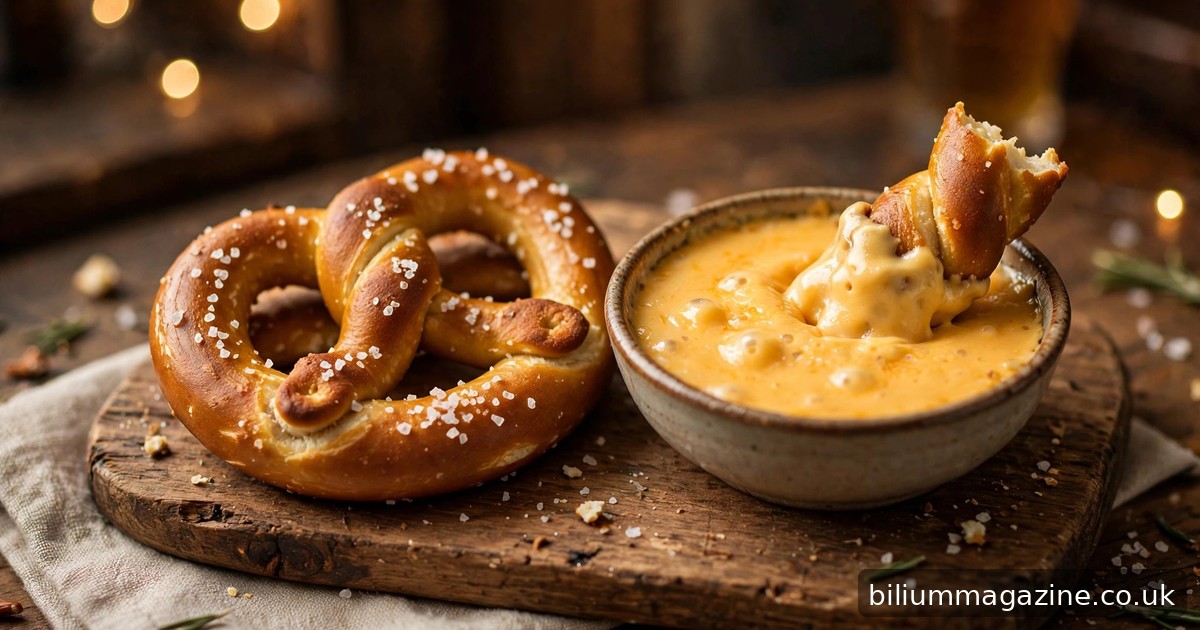
The pretzel. A proper soft pretzel gets its dark, glossy crust from a brief bath in an alkaline solution (lye traditionally, baking soda at home) before baking — that’s what gives it the distinctive pretzel flavor, slightly mineral and toasty, with a chewy crumb inside. Signs of quality: a deep brown crust (not pale blond), visible coarse pretzel salt, a soft interior that tears rather than crumbles, and warmth. A pretzel served at room temperature has already lost half its charm; one that’s pale and bread-like was probably baked from frozen without the alkaline dip. Size and shape are preference — the classic twist, Bavarian sticks, bite-size nuggets — but fresh-baked beats reheated every time. Some of the best pub versions come out of pizza ovens, which give the crust extra crispness.
The dip. It should be served hot and stay fluid — a dip that skins over or seizes into a rubbery mass within minutes was made with too much starch or held too long. Flavor-wise, look for balance: sharp cheddar character, a whisper of beer bitterness in beer cheese versions, enough salt to stand up to the pretzel’s salt (yes, both are salty — that’s the point), and in spicier versions, heat that builds rather than scorches. The dip should coat the pretzel, not slide off it. And quantity matters: a thimble of dip for a jumbo pretzel is the classic restaurant stinginess — a good portion gives you roughly a one-to-three ratio of dip to pretzel.
The supporting cast. Many places serve a second dip — honey Dijon mustard or horseradish mustard are the standards — and that’s a good sign, not a distraction. The mustard’s sharpness cuts the richness and gives you a second flavor lane. If a place offers only the cheese, it should be confident enough to carry the plate alone.
How to Find the Best Pretzel with Cheese Dip Near Me
This dish lives in specific habitats. Knowing where to look saves you from scrolling through pizza places that happen to have frozen pretzel bites.
Start with pubs, brewpubs, and sports bars. This is the dish’s natural habitat. Brewpubs are the sweet spot — places that brew their own beer often make their beer cheese with it, and the pairing is the point of the menu. Search “brewpub near me” or “beer cheese pretzel near me” rather than the generic phrase; you’ll surface the places that take it seriously.
Don’t sleep on the chains — some are genuinely good. A few national chains have turned this into a signature. Yard House serves a jumbo Bavarian pretzel with a house hazy IPA cheddar beer cheese and horseradish mustard. BJ’s Restaurant & Brewhouse does a Big Twist baked in their pizza oven with a blonde beer cheese and honey Dijon. Applebee’s pairs Bavarian-style pretzel sticks with a Blue Moon white cheddar beer cheese. Mellow Mushroom’s pretzel bites come with a beer cheese that regulars praise, with a spicy version available. Red Robin’s pretzel bites with Fat Tire beer cheese are a budget standout — one widely shared review put 15 bites at $5. These are consistent, widely available, and as of 2026 still on menus.
Check mall pretzel shops for the quick fix. Wetzel’s Pretzels and similar mall chains serve fresh-baked pretzels with warm cheddar or jalapeño cheese dips — not beer cheese, but hot, salty, and satisfying when the craving hits during a shopping trip. It’s the fast-food version of the dish: simpler, cheaper, no beer, still good.
Read reviews for temperature words. Search reviews for “warm,” “fresh-baked,” “hot,” and “beer cheese” — and for the negatives: “cold,” “stale,” “congealed.” Temperature is the single biggest quality divider for this dish, and reviewers mention it constantly. Our guide to finding the best restaurants near you explains the review-reading technique in more detail, including how to filter for reviewers who describe the actual food rather than the atmosphere.
Ask about the beer in the beer cheese. If a menu says “beer cheese” but the staff can’t tell you what beer is in it, it’s probably a mix with beer flavoring. A place that names the beer — a house IPA, a local lager — is making it from scratch, and the dip will taste like it.
What to Expect: Prices in 2026
Pretzel with cheese dip is one of the great value appetizers, and prices reflect that. At mall pretzel shops, a pretzel with a cheese dip runs roughly $6–$10. At casual chains and pubs, expect $9–$15 for a full appetizer portion — the Red Robin bites deal aside, most sit-down portions land around $11–$13. At brewpubs with house-made beer cheese and jumbo pretzels, $13–$18 is normal, and worth it when both components are made in-house.
Portion logic: a “jumbo” or “Bavarian” pretzel is genuinely shareable between two people as a starter; pretzel bites are the better call for groups, since everyone gets their own dipping pieces and the cheese-to-pretzel ratio stays right. As a main for one hungry person? The bites platter plus a beer is a legitimate dinner — no judgment.
One pricing trap to watch: some upscale gastropubs charge $16+ for what turns out to be three small reheated pretzels and a ramekin of cheese. Check menu photos before committing at that price point. If the pretzel looks pale and the dip looks like it came from a pump, walk your wallet elsewhere.
Making It at Home: Easier Than You Think
Both halves of this dish are weeknight-doable, and the homemade version can beat most restaurants because you control the two things restaurants most often get wrong: temperature and freshness.
The pretzel shortcut. From-scratch soft pretzels are a project (though a fun one). The practical shortcut is frozen soft pretzels — widely available — baked fresh and brushed with melted butter, then sprinkled with coarse salt. They’ll never match a lye-dipped fresh pretzel, but hot from your oven with real butter, they’re 85% of the way there. For the full project, the key steps are a baking-soda water bath before baking (the home substitute for lye) and a hot oven — 450°F / 230°C — for that dark crust.
The beer cheese. This is where homemade shines, because restaurant beer cheese is often held too long. The method: melt 2 tablespoons of butter, whisk in 2 tablespoons of flour to make a roux, then slowly whisk in half a cup of beer (a lager or amber ale — nothing too hoppy or it turns bitter) and half a cup of milk. Simmer until slightly thickened, then stir in 2 cups of shredded sharp cheddar a handful at a time until melted and smooth. Season with a teaspoon of Dijon mustard, a dash of Worcestershire sauce, garlic powder, and cayenne to taste. Serve immediately — beer cheese waits for no one. It reheats okay with a splash of milk, but it’s never as good as fresh.
The no-beer version. Swap the beer for milk or chicken stock and you have a straight cheddar dip; add diced pickled jalapeños for the jalapeño-cheese style. Same roux method, same immediacy.
Total active time: about 30 minutes if the pretzels are frozen, 90 if you’re making dough. Serve the dip in a warmed bowl — a cold bowl steals heat fast — and put the pretzels on a wooden board, not a cold plate.
Frequently Asked Questions
What kind of cheese is best for pretzel dip?
Sharp cheddar is the classic base — it melts smoothly and has enough flavor to stand up to beer and mustard. For beer cheese, a mix of sharp cheddar with a little Gruyère or smoked Gouda adds depth. Avoid pre-shredded cheese if you can; the anti-caking starch makes dips grainy. Shred from the block.
What beer should go in beer cheese dip?
A malty lager, amber ale, or brown ale — something with body and not too much hop bitterness. Very hoppy IPAs can turn the dip bitter, though some brewpubs (like Yard House with its hazy IPA cheddar) pull it off by balancing with enough cheese and cream. When in doubt, use what you’d drink with the pretzel.
Are pretzel bites or a full pretzel better?
For dipping, bites win — more surface area, better cheese-to-pretzel ratio, easier sharing. For atmosphere, the jumbo twist torn apart at the table wins. Order bites for groups, the big twist for the experience.
Can you reheat beer cheese dip?
Yes, gently: low heat, a splash of milk or beer, constant stirring. Don’t microwave it on high — the cheese will break and turn greasy. Honestly, though, it’s a make-and-serve-fresh dish; leftovers are never as good as the first bowl.
Is beer cheese dip actually alcoholic?
Barely. The beer is simmered during cooking, which drives off most of the alcohol — what remains is flavor, not booze. The residual alcohol in a serving is negligible, roughly on par with vanilla extract in baked goods.
What’s the difference between beer cheese and cheese dip?
Beer cheese is a specific thing: cheese melted with actual beer, originating in Kentucky in the 1930s, with a characteristic tangy-bitter edge. “Cheese dip” is the generic term — it might be beer cheese, or it might be a plain cheddar or nacho-style dip with no beer at all. Menus sometimes use them interchangeably, so ask.
The Takeaway
The best pretzel with cheese dip near me is the one served hot: a deeply browned, salted pretzel with a chewy crumb, and a dip — beer cheese if you’re lucky — that’s molten, balanced, and generous. Hunt in brewpubs first, trust the chains that made it a signature, read reviews for temperature words, and ask what beer is in the cheese. And if the search fails, thirty minutes in your own kitchen will produce a version most restaurants can’t touch — because nothing beats a pretzel that’s still warm from the oven.
