

Best Pisto Manchego Near Me: Finding Spain’s Great Stew
If you’re hunting for the best pisto manchego near me, you’ve probably already discovered the problem: most Spanish restaurants don’t serve it, and the ones that do vary wildly. Pisto manchego — the slow-cooked vegetable stew of Spain’s La Mancha region — is one of those dishes that’s simple on paper and brutally revealing in practice. Eggplant, zucchini, peppers, onion, and tomato, cooked down in good olive oil until everything is tender and sweet. When it’s right, it’s one of the most satisfying vegetable dishes in Europe. When it’s wrong, it’s a sad pile of mush.
The good news: once you know what proper pisto tastes like and which kitchens take it seriously, finding a great version gets much easier. This guide covers the dish’s identity, the quality signals that separate excellent from mediocre, where to search, what it costs, and how to make it at home when the restaurants let you down.
What Pisto Manchego Actually Is
Pisto manchego is the signature vegetable dish of La Mancha, the windswept plateau of central Spain famous for Don Quixote, Manchego cheese, and saffron. At its core it’s a peasant stew: the summer vegetables of the region — eggplant, zucchini (or calabacín), red and green peppers, onion, and ripe tomatoes — cut into pieces and cooked slowly in generous olive oil until soft, sweet, and deeply savory.
Foreigners often call it “Spanish ratatouille,” and the comparison is fair as far as it goes — both are Mediterranean vegetable stews. But the technique and character differ. Where Provençal ratatouille often keeps its vegetables in distinct, almost salad-like pieces, pisto cooks everything down further into a cohesive, spoonable stew, bound by the tomatoes and glossed with olive oil. The seasoning is restrained: salt, maybe a little garlic, sometimes a pinch of cumin in some households (a debated addition — purists skip it). The olive oil isn’t just a cooking medium; it’s a flavor component you should taste in the finished dish.
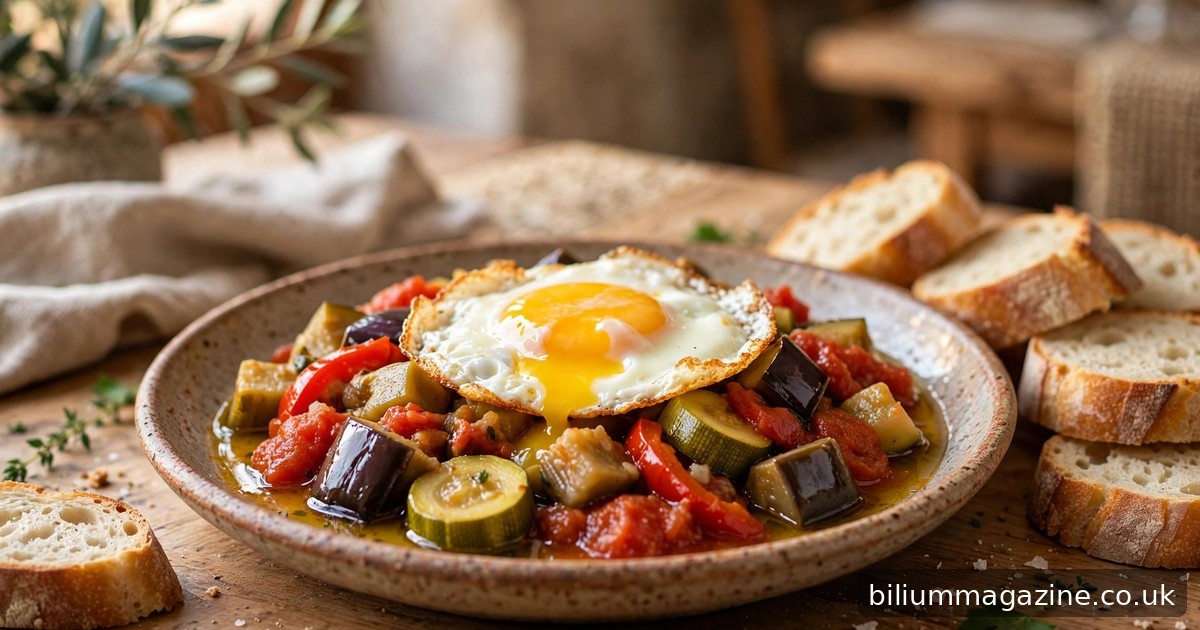
In Spain, pisto is everyday food, not restaurant showmanship. It appears as a tapa, a side dish alongside grilled meats or fried eggs, or a light meal on its own with crusty bread for mopping up the oil. The classic presentation — the one that signals a kitchen understands the dish — is pisto served with a fried egg on top, the runny yolk enriching the vegetables. Some versions add bits of jamón or chorizo, but the base is vegetarian, and many Spaniards eat it that way.
There’s also a practical tradition worth knowing: pisto is frequently made in large batches and preserved — jarred or canned — for winter. In La Mancha, home cooks put up pisto in summer when the vegetables are at their peak. That tells you something important about seasonality, which we’ll come back to.
What Makes a Great Pisto Manchego
The ingredient list is short, so execution is everything. Here’s the quality checklist.
- Vegetables cooked in stages, not dumped together. Eggplant, zucchini, peppers, and onion all cook at different rates. A careful kitchen cooks them separately (or at least staggers them) so each reaches tenderness without the others collapsing. The single most common failure — everything thrown in one pot at once — produces mush with no distinct flavors.
- Tender but distinct. You should be able to identify each vegetable in the spoon: the silk of eggplant, the sweetness of pepper, the body of zucchini. If it’s a homogeneous purée-like mass, the kitchen overcooked it or blended it. Some restaurants do blend pisto into a sauce — that’s a different dish, and not what you’re looking for.
- Deep tomato flavor. The tomatoes should taste cooked down and concentrated — sweet, slightly caramelized — not raw and acidic. Summer tomatoes make this easy; out of season, good canned tomatoes are the honest choice, and better than pale winter fresh ones.
- Olive oil you can taste. This is the great divider. Cheap or neutral oil makes pisto taste flat and greasy; good extra-virgin olive oil — fruity, with a peppery finish — makes it taste alive. You should see a light gloss of oil and taste it as a distinct, pleasant component.
- Restrained seasoning. Salt should be present but not aggressive; the vegetables are the point. Over-spicing (heavy cumin, smoked paprika dumped in) is a kitchen compensating for bland vegetables.
Color tells a story too: proper pisto is a rich mosaic — red from tomato and pepper, golden from onion and oil, deep purple-brown from eggplant — with some caramelized edges. A uniform dull orange-brown suggests it was cooked too long at too low care.
How to Find the Best Pisto Manchego Near Me
Pisto is a niche menu item even in Spanish restaurants, so the search strategy matters more than usual.
Search Spanish restaurants first, then verify the menu. “Spanish restaurant near me” and “tapas bar near me” are the starting queries. But don’t stop at the cuisine label — open the actual menu and search for “pisto.” Many Spanish restaurants, especially those leaning toward Galician or Basque cooking, never serve it. Restaurants with Castilian or Manchegan roots, or those that emphasize traditional home-style cooking, are the best bets. If the menu is online, a quick text search saves a phone call.
Call before you go. Pisto is often a rotating or seasonal item rather than a permanent fixture — some kitchens make it only in summer, or only on certain days, or only as a special. A thirty-second call (“Do you have pisto manchego on the menu right now?”) prevents the disappointment of arriving to find it absent. While you’re on the phone, ask whether it’s served with a fried egg — a yes suggests the kitchen knows the traditional presentation.
Ask about the olive oil. This sounds fussy; it’s actually the fastest quality filter there is. “What olive oil do you cook with?” A kitchen that answers specifically — a Spanish extra-virgin, a named producer — takes the dish seriously. A vague “olive oil” or “vegetable oil” answer tells you the pisto is an afterthought. No good pisto was ever made in neutral oil.
Read reviews for texture words. Search reviews for “pisto” and look for descriptions of the vegetables: “tender,” “fresh,” “not mushy,” “flavorful.” Complaints about mushiness or blandness, repeated across reviews, are a reliable pattern — this dish fails the same way everywhere, so the warnings rhyme. Our guide to finding the best restaurants near you explains the review-reading approach in more detail, including how to weigh recent reviews over old ones when judging a seasonal dish.
Try Spanish delis and markets. Like many traditional dishes, pisto sometimes appears at Spanish specialty grocers — sold jarred (imported from Spain, quite good) or from a prepared-foods counter. Imported jarred pisto from Spanish brands is a legitimate product, made the traditional way for the Spanish market, and it beats a mediocre restaurant version easily.
Time it for summer and early fall. Pisto is at its best from roughly July through October, when tomatoes, peppers, eggplant, and zucchini are at peak. Spanish restaurants that care about the dish feature it more prominently then; out of season, even good kitchens may drop it or make a lesser version. If you’re hunting in February, temper expectations — or wait.
What to Expect: Price and How It’s Served
Pisto is humble food, and it’s priced that way. As a tapa or side at a Spanish restaurant in the US, expect $8–$14 as of 2026; as part of a larger plate or with a fried egg as a light main, $14–$20. In Spain itself, it’s a few euros as a tapa — which tells you something about its soul: this was never meant to be expensive.
How it arrives matters. The traditional service is warm (not piping hot, not lukewarm) in a shallow bowl or cazuela, with bread alongside — the bread is not optional garnish, it’s equipment for the olive oil and tomato juices. The fried-egg-on-top presentation is the classic full serving; as a side with grilled meat or fish, it comes unadorned. If it arrives stone cold or swimming in thin liquid, the kitchen isn’t paying attention.
One more expectation to set: pisto is rarely the star of a Spanish restaurant’s menu, and that’s fine. Judge it as the kitchen’s character witness — a place that makes careful pisto almost certainly makes careful everything else. Order it alongside the restaurant’s grilled meats or a tortilla española and let it tell you about the kitchen.
Making It at Home: The Honest Shortcut
Here’s the open secret: homemade pisto, made with good summer vegetables and real olive oil, will beat most restaurant versions — because most restaurants won’t spend the time on staged cooking that the dish requires. It’s not difficult; it’s patient.
The method: dice one eggplant, two zucchini, one red pepper, one green pepper, and one large onion. Heat a generous glug of extra-virgin olive oil (don’t be shy — a third of a cup for this quantity) in a large, heavy pan. Cook the onion first until soft and golden, about 8 minutes; remove. Then the peppers, 6–7 minutes; remove. Then the zucchini, 5–6 minutes; remove. Then the eggplant, which drinks oil — add a little more if needed — until golden and tender, 7–8 minutes. Return everything to the pan, add 800g of chopped ripe tomatoes (or a large can of good San Marzano-style tomatoes out of season), a pinch of salt, and simmer 20–25 minutes until thick and cohesive. Taste for salt. That’s it.
The staged cooking is the whole trick — it’s what keeps each vegetable distinct instead of collapsed. Total time is about an hour, most of it pleasant stove-tending. Serve warm with a fried egg on top and the best bread you can find. It keeps 4–5 days refrigerated and, true to the Manchegan tradition, it cans and freezes beautifully — make a double batch in August and you’ll eat well into autumn.
If even that sounds like too much, the store-bought shortcut is real: imported Spanish jarred pisto (look for it at Spanish delis or online) is made for the Spanish home market and is genuinely good warmed through with a fried egg on top. It’s the rare convenience product with no apology needed.
Frequently Asked Questions
What is pisto manchego made of?
Eggplant, zucchini, red and green peppers, onion, and tomatoes, slow-cooked in generous extra-virgin olive oil with salt. Some family recipes add garlic or a pinch of cumin; the classic serving includes a fried egg on top. It’s from La Mancha in central Spain.
Is pisto manchego the same as ratatouille?
They’re cousins, not twins. Both are Mediterranean vegetable stews, but pisto typically cooks the vegetables down further into a cohesive, spoonable stew bound by tomato and olive oil, while ratatouille often keeps more distinct pieces. The seasoning differs too — pisto is more restrained, letting the olive oil speak.
Is pisto manchego vegetarian?
The base dish is vegetarian (vegan, in fact, without the egg). Some versions add jamón or chorizo, and the classic presentation includes a fried egg — so ask if you’re vegetarian or vegan. Most kitchens can serve it without the egg.
When is pisto manchego in season?
Summer through early fall — roughly July to October — when tomatoes, peppers, eggplant, and zucchini are at their peak. That’s when restaurants serve their best versions and when it’s worth making at home. Out of season, good canned tomatoes beat bad fresh ones.
Can you eat pisto manchego cold?
Yes — it’s traditionally served warm or at room temperature, and many Spaniards eat leftover pisto cold or room-temp the next day, often on toast. It’s one of those dishes that doesn’t suffer from waiting, which is why it travels well as a tapa.
Where can I buy pisto manchego near me?
Beyond restaurants, check Spanish specialty delis and the international aisle of well-stocked grocers for imported jarred pisto from Spain — it’s made for the Spanish home market and is genuinely good. Spanish markets with prepared-food counters sometimes sell it fresh by weight.
The Takeaway
The best pisto manchego near me is the one where you can taste each vegetable, taste the olive oil, and taste the care: tender-not-mushy, deep with tomato, glossed with good oil, served warm with bread for mopping. Search Spanish menus for the word “pisto,” call ahead (it’s often seasonal), and ask about the olive oil — the answer tells you everything. And if the local options disappoint, an hour at your own stove in late summer will produce a pisto that most restaurants can’t match.
